AGRICULTURE AND NUTRITIONAL HEALING
With this issue we are starting
(with) a series written by Don Sadhu, an organic farmer and free lance
writer/lecturer who just moved to the island. His adventurous life has
brought him from Europe to India, the United States and now to Puerto
Rico, where he works on a farm project (Govardhan Gardens/Bo. Bateyes)
that is dedicated to self sufficiency ideals and organic agriculture.
This series of articles which he was happy to contribute to Agrotemas
is focused on the issue of nutritional healing.
Nutritional Healing in the Life
of an Agronomist.
An agronomist is defined as "an
expert or scientist of farm management and the production of field
crops." What makes someone expert in management and production is his
ability to do these tasks successfully with long-term positive
results. We all know that there is a direct relationship between us
and our environment. Our closest environment is our own body which is
nourished and sustained by external elements. When we look around,
however, we all can notice, however, that despite all progress that we
have made in various fields of knowledge, that there is an undeniable
fact: there are few healthy and satisfied people on the planet.
Although most people are used to expect new miracles from politicians,
doctors, scientists, etc., we shouldn't fool ourselves and acknowledge
the fact that nothing can replace a healthy lifestyle for which we
have to take the main responsibility. Why rely on others when nature
has given us an incredible inner healing force — our immune system,
that needs to be protected and nourished by a healthy way of life.
What makes a lifestyle healthy?
It is easy to understand the answer by analyzing the opposite: what
makes us sick?
The main causes for disease can be found in three categories:
1. Mal-nutrition,
2. Pollution
3. Unhygienic environment
4. Psychological factors like:
stress,
anxiety,
depression,
etc.
Of these three factors, the intake
of food is extremely important since we have to eat every day, and
whatever we eat either improves our health or makes us more sick. If
we take a closer look we will realize that the lives of farmers are
very closely connected to these factors. Farmers are the ones who are
responsible for the quality of food that we all eat. Since farmers
generally possess larger areas of land, they also have a major
responsibility towards the environment. Concerning the psychological
factors causing disease, it is up to the individual farmer whether he
joins the rank of ruthless agribusiness people or dedicates his life
to an intelligent and peaceful coexistence with nature. We can clearly
see that we, the ones who dedicated our lives to farming, have a major
responsibility towards society, our families as well as ourselves.
Since we do have so much natural responsibility arising resulting from
our occupation, we should make it our goal to set a leading example
for society by producing healthy food with means that are thoughtful
and in tune with nature.
There is a very common trap that many people fall into: as soon as we
experience a problem, we are looking for a quick, cheap and easy
solution, and we tend to blame someone else for it. This type of
attitude also led many, if not most farmers to give up holistic
farming and turn towards developing monocultures. The experienced
problem was insufficient amount of income. The apparently best
solution was considered to be cultivating the most profitable crop
possible. The unavoidable problem that came along with it:
monocultures are easily discovered and attacked by various pests. The
apparently only solution: chemical warfare and gene-manipulation with
effects that eventually turned out to be disastrous. The quick, easy
and cheap solution turned out to have a high price: we damage our
environment, lose our integrity and health and endanger that of
others.
How often do people ask me: "Which herb is best for my problem?" We
cannot expect to make fundamental mistakes on different levels, and
then simply take one pill to solve our problem. Therefore we have to
take a holistic, mature approach of realizing what the actual root of
our problem is, and then what the most natural way of solving it is.
E.g. as long as we eat junk food, don't have any physical exercise in
fresh air at all, depend on drugs and stick to all sorts of other
harmful habits, it is simply ludicrous to expect to be healed by any
single herb or chemical pill. In fact, nature is designed in a way
that we can stay fit simply by eating wholesome, healthy nutrition and
leading a lifestyle that is free from the toxins called unscrupulous
greed and ignorance. As Socrates once said, "There is only one good —
knowledge, and one evil — ignorance"; let us be guided in all of our
actions by factual knowledge and the desire to contribute good — to
our environment and consequently to ourselves.
Nature has provided for our medicine in the form of fantastic fruits,
vegetables, nuts, grains and milk products — food that can be obtained
in a nonviolent and spiritually uplifting way. "Your food shall be
your medicine" was an intelligent and timeless maxim by the father of
western medicine, Hippocrates. Why go on eating without getting proper
nourishment and why risk to simply increase diseased organisms in our
bodies by continuing to eat denatured, artificially flavored,
gene-manipulated and chemically treated food? The only explainable
reasons behind that would be greed (which leads to exploitation of our
environment) and foolishness (which makes us blind to the fact that we
are poisoning ourselves and others). On the other hand, once we
understand and appreciate the miracle foods that surround us, it will
allow us to take a very active role of our health, and that of
thousands of others who we provide with what we grow.
With this brief introduction I want to lead you to a series of
articles that deals with studies of food values as well as curative
and natural benefits of foods that are common and easy to grow here in
Puerto Rico - an island that makes it easier to realize agricultural
ideals than many other parts of our world. |








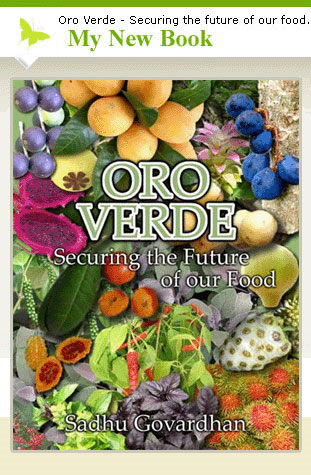


 Sadhu
Govardhan is an independent thinker, eco-organic farmer, tropical
rare fruit connoisseur and researcher. Extensive journeys for over
twenty years have allowed him to study indigenous cultures and
different life styles throughout the world.
Sadhu
Govardhan is an independent thinker, eco-organic farmer, tropical
rare fruit connoisseur and researcher. Extensive journeys for over
twenty years have allowed him to study indigenous cultures and
different life styles throughout the world.

 I would like
to extend a heartfelt thanks to everyone who has helped out this
project over the years. Even if I can't acknowledge all of you
individually since so many people have supported Govardhan Gardens
in so many ways, I certainly remember every one of you.
I would like
to extend a heartfelt thanks to everyone who has helped out this
project over the years. Even if I can't acknowledge all of you
individually since so many people have supported Govardhan Gardens
in so many ways, I certainly remember every one of you. 

