BAMBOO NURSERY
Opened in 2007, Govardhan Gardens Bamboo Nursery is the first highly diversified tropical bamboo nursery in Puerto Rico and the Caribbean. In order to serve local farmers and bamboo growers, I am regularly propagating the best species existing for construction, wind breaks, erosion control, privacy screens, fast shade provision, landscaping and edible shoots.
Especially after going through the devastating hurricane, Maria in September 2017, I am determined to help everyone who wants to create a healthy and strong eco system by providing the highest quality tropical bamboo species existing on the planet. Of all the surviving plants at my own farm, specific bamboo species have been the most resilient ones. Living bamboo fences are affordable, especially at whole sale quantities, and the best natural long-term solution to protect any land in the tropics from extreme winds and erosion.
Since the inventory of available bamboo species is constantly changing, I am regularly updating the times of availability for each species listed below. Please reserve your plants on time!!
All sales are local, I do not ship bamboo. Please inquire about prices. Most specimen are sold in 2 or 3 gallon containers and are ready to be planted right away. Enjoy the numerous species available throughout the year!
|
Bambusa lako (Timor Black Bamboo)
From the Indonesian island of Timor. One of the world’s most beautiful bamboos and a prized collector’s species. Culms emerge green and mature to a shiny chocolate black, with an almost purplish tint. Grows erect and arches at the top. Can be planted either as a specimen/focal point, in a row along a path/road/stream, or among other tropical foliage. Slightly open clumper with very straight growth. 45' tall with 3-4" diameter culms. Valuable for furniture and musical instruments. Shoots are edible but not of high quality. Can be planted in full sun; ideal windbreak (holds up very well in storms and even hurricanes). It's disease and drought resistancy make it an ideal species for wide propagation. Limited stock available again in June 2021.
|
Guadua angustifolia (Guadua)
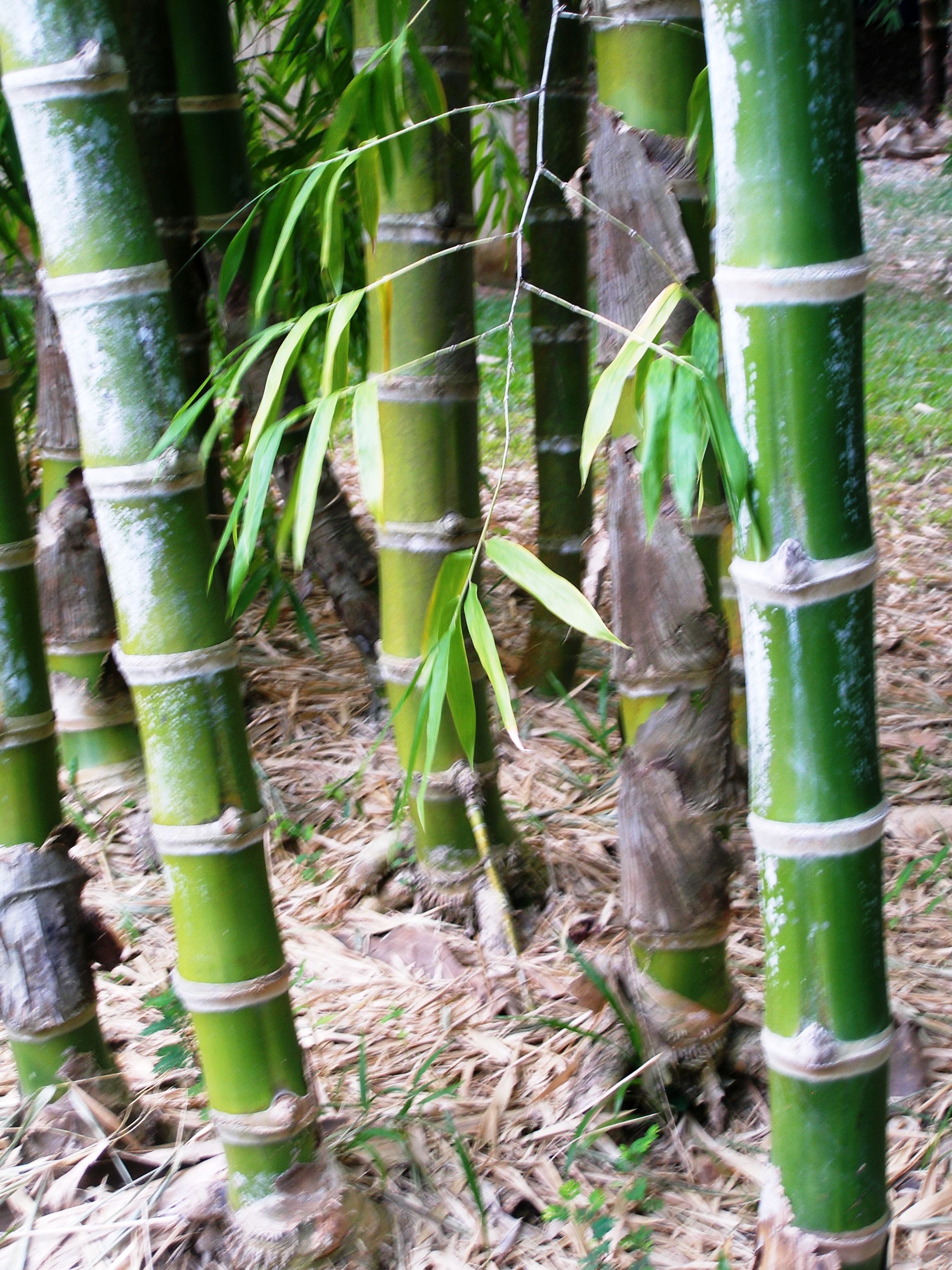
This is one of the few species that originates in South America and it is very similar in quality to superior bamboos of South East Asia. This species is ideal for use in heavy construction. It is an open clumper, which means that it requires more ground space than many other large species. It can grow up to 75 feet and a mature clump looks quite impressive.
Guadua angustifolia is in high demand and will sell out fast, please make your order on time. My Guadua stock for 2020/21 is depleted but the species should be available again by 2023.
|
Dendrocalamus asper, green
(Asper Bamboo)
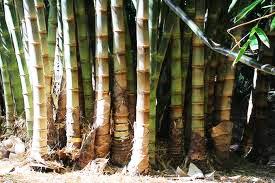
Native to Indonesia, cultivated throughout Asia. Grows to 75 feet, with a diameter of 5 to 8 inches. One of the best timber bamboos existing. Used for construction as well as for its high quality edible shoots. New shoots look spectacular. There is a green and a black type, and I am mostly propagating the green one. If you want to have only one large, high quality structural species, this is the one! The green type will be available throughout 2022 and 2023.
Plants are currently available! Since this species is in high demand, please reserve your plants as soon as possible.
|
|
Schyzostachyum brachycladum (Sacred Bali Bamboo)
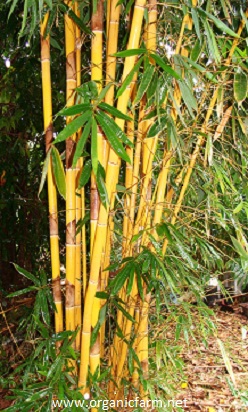
One of the most striking bamboo species existing. Golden-yellow with vertical green stripes.
Its primary use is decorative - it makes a beautiful center piece in any landscaping arrangement - and as a source of large amounts of organic matter (fallen leaves). It is also ideal for erosion control. This species is too thin-walled for construction but one can make woven ropes out of split and pounded culms. 35 feet with 2 inch culms.
Limited amount available by order.
|
Dendrocalamus strictus (Male Bamboo)
Origin: India. This species grows in a very tight clump, up to 45 feet with a 2.5 – 3 inch diameter. D. strictus is a very popular structural bamboo in India (it covers over 50% of all bamboo grown there), and it is also used for pulp/paper production. It can be grown under dry and wet conditions, in a variety of soils but it does require good drainage.
D. strictus is often planted to reclaim ravine land in India. Its culms are almost solid and thus very strong. Its tensile strength is close to that of mild steel. Besides used in construction (where it is also becoming increasingly used to reinforce concrete), it is also used for furniture and musical instruments. The young shoots are edible, and a decoction of the leaves and nodes is used for medicinal purpose.
D. strictus makes a good living fence and is the most affordable species in my nursery. For this reason, it is high in demand and I need several months time to propagate enough for a large order (50 specimen +). Currently sold out; will be available again in November 2021.
|
Bambusa arnhemica (Tricolor Bamboo)
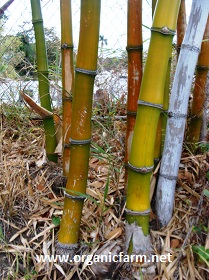 This interesting Australian species usually has three culm colors in the same clump: green, yellow, and a spectacular sunset orange. Its very thick-walled and of superior structural quality. At the same time, it is highly ornamental and doesn't take up much space - an open clumper that fits even into residential properties. This interesting Australian species usually has three culm colors in the same clump: green, yellow, and a spectacular sunset orange. Its very thick-walled and of superior structural quality. At the same time, it is highly ornamental and doesn't take up much space - an open clumper that fits even into residential properties.
This bamboo is highly resistant to termites, and grows only to about 20 feet, with a 2 - 2.5 inch diameter. Highly recommendable.
Only a few specimen left. Available now!
|
Thyrsostachys siamensis (Monastery Bamboo)
Originates in Thailand. Coveted collector's species because of its graceful appearance. High quality structural bamboo with almost solid culm walls. Even without treatment, harvested culms often last for many years without deteriorating.
Grows very straight, lower part of culms branchless. Very popular ornamental bamboo with edible shoots, often planted to block out sound and view. Easy to grow (full sun or light shade), ideal for erosion control. Grows up to 40 feet (but often remains lower, around 20-30 feet), with a diameter of 3 inches. The culms are used to make tools.
This species is one of the best multi-purpose bamboos and therefore extremely popular for living fences, "tunnels", etc. Please reserve your plants in time in case you need larger amounts of this species.
Only a few specimen left. Available now!
|
These additional species can be ordered in small quantities or are currently available:
Bambusa balcooa
75', 5" diameter. Origin: India. Good structural bamboo but requires lots of space and is relatively difficult to harvest (because of it's horizontal branches). Availability: December 2018 .
Bambusa chungii
30', 2.5" diameter. Beautiful, ornamental species. Too thin-walled for construction but used for weaving and handicrafts. Only propagated by order.
Bambusa distegia
30', 2.5"-3" diameter. Similar like B. textilis but longer leaves. Ideal for smaller spaces. Straight culms with nodding tops. Drought and wind resistant. Rare, only a few specimen will be available in December 2018.
Bambusa emeiensis
35', 2.5" diameter. Very attractive and rare species. Striped culms and very beautiful shades of green. One of the best tropical landscape bamboos. Useful for light construction. Availability: only by order.
Bambusa lapidea (Horsehoof Bamboo)
25-45', 2.5" diameter. Base of culms almost solid; used for construction.
Available in June 2019.
Bambusa multiplex
25', 2" diameter. Very popular species for hedges; due to its relatively small size, it is often planted in gardens for its ornamental appearance. Cooked shoots are edible. Commonly used for weaving, screens, handicrafts. Availability: June 2019.
Bambusa oldhamii
50', 4'' diameter. Very straight growing species, extensively used to make furniture, but not suitable for construction projects. High quality edible shoots. Often used as windbreak. Availability: only by order.
Bambusa polymorpha
60', 4'' diameter. Originates in India and Burma. Decorative timber species. Culms solid, graish-green. Grows best in humid areas. Edible shoots. Rare.
Available now!
Bambusa pervariabilis viridistriata
45', 2.5" diameter. Very attractive yellow-golden culms with cream stripes on the basal nodes. Commonly used for light poles/rods, furniture and farm tool handles.
Availability: only by order.
Bambusa sp. solid culms
12-20', 1.5-2" diameter. Rare species.
Availability: July 2023.
Bambusa textilis
30', 1.5'' diameter. Elegant, tight clumping species. Shoots edible. Ideal for living fences/privacy screens.
Out of stock. Back in 2023.
Bambusa tulda
60', 5" diameter. Very high tensile strength, almost solid. Used extensively for furniture making and to reinforce concrete. Available again in March 2023.
Bambusa tuldoides
35', 2.5" diameter. Very important, thick-walled and upright growing species with one of the highest tensile strengths (40 000 psi). One of the most used smaller structural bamboos in Asia. This is a must have for anyone interested in furniture making or bamboo construction. Available again in July 2022.
Bambusa ventricosa
50', 2" diameter. There are two main types of this species: a straight growing one, and one with swollen internodes (known as Buddha's belly bamboo). Extensively used for windbreaks and erosion control. Makes an impenetrable hedge. Shoots are edible.
Out of stock. Back in 2023.
Cephalostachyum pergracile
Spectacular bamboo, often used for living fences; grows to 30 feet; bluish culms with copper-colored culm sheaths. Availability: sold out.
Dendrocalamus barbatus
40-50', 4-5" diameter; thick-walled highly attractive Chinese species for construction, edible shoots; also used for charcoal productions. Availability: only by order.
Dendrocalamus brandisii
40-60', 4" diameter; Large structural species with excellent shoots that can be eaten raw. Rare and wherever grown used for major construction, especially houses. Limited stock.
Availability: a few specimen now (2022).
Dendrocalamus copelandii
40-60', 4" diameter. The introduction of this species into the Caribbean is a historical event. D. copelandii is very rare and one of the most stunning tropical bamboo species. The culms are contorted and look like elephant trunks. Its like a small version of D. sinicus, which is also extremely rare. It has excellent edible shoots, is used in construction and in high end landscaping. Limited stock. Very few specimen left!
Dendrocalamus dumosus
12-18', 1" diameter. Excellent ornamental for landscaping, best on steep slopes, edges, terraces. Limited stock. Rare. Only a few left. Only a few specimen left!
Dendrocalamus fuminensis
40-60', 4-5" diameter. Used for construction, paper production, in land scaping. Limited stock. Rare but low price. Available now!
Dendrocalamus giganteus
50-110’, 5-12” diameter; native to India, Thailand, Burma, Sri Lanka; rare; this is one of the largest existing bamboo species and a real show stopper; used for heavy construction; good edible shoots; lower nodes may be branchless for 40’ or more. Leaves grow to 20”. Rare. Available May 2021.
Dendrocalamus hamiltonii
40'-60', 3-3.5" diameter. One of the best sources for raw bamboo shoots (one of the sweetest types). Good for construction; very large and ornamental leaves.
Dendrocalamus latiflorus
50-80', 4-7" diameter; a famous timber bamboo from southern China and Taiwan, mostly known for its high quality edible shoots. Striking, large leaves and an overall majestic appearance - a must in every bamboo collection. Availability: January 2022.
Dendrocalamus minor
25', 1.5" diameter; ornamental species with clean, smooth culms; long slender arching tops; easy to grow. Availability: January 2022.
Dendrocalamus peculiaris
Very beautiful ornamental species from China. Grows to 35-50' tall with 4-5" diameter culms. Easy to grow in humid area and moisture-retaining soils. Widely used for construction, furniture, plywood, weaving and for landscaping. Available: June 2022.
Dendrocalamus sikkimensis
60', 6" diameter. One of my favorite bamboo species. The culms turn orange-bronze with age if planted in full sun or light shade. Often used for water pipes and general construction. Edible shoots of high quality. Rare.Availability: only by order.
Gigantochloa apus
60', 4" diameter. This species is used extensively in Indonesia for roof rafters. Split culms are used for baskets or made into ropes. Cooked shoots are excellent.
Availability: only by order.
Gigantochloa atter
60', 5" diameter. This magnificent species is very fast growing and a classic in the bamboo world. Ideal for construction and furniture, with high quality edible shoots.
Availability: only by order.
Gigantochloa felix
30', 2.5" diameter. Mostly grown as an ornamental. Cultivated in southern Yunnan, China. Culms are used for furniture and light construction. Rare. Available: October 2022.
Guadua amplexifolia
40', 4" diameter. Smaller, less thorny relative of G. angustifolia. Highly recommendable for construction but needs to be very well cured because it appears to be more susceptible to insects than G. angustifolia .Availability: only by order.
Guadua aureocaulis
40', 4" diameter; Bright colored, highly attractive culms with random green stripes and white nodal rings, and variegated leaves. One of my favorite bamboo species (also known as "moonlight bamboo"). Suitable for heavy construction. Availability: only by order.
Melocanna baccifera
50', 3.5" diameter. Also known as "berry bamboo" because of its large fruits. Although the fruit is supposedly edible, I haven't been able to figure out yet how to eat it - no matter at what stage I harvested the fruit, it was extremely hard. The shoots are edible and the species is widely used for weaving (mats, baskets, hats, etc.). Availability: only by order.
Nastus elatus
50', 4" diameter. This New Guinea species is considered to be one of the best edible bamboos: the deliciously sweet shoots can even be eaten raw. It is recognized by its drooping culm tips, and although it requires relatively much water, it only grows well if there is sufficient drainage. Availability: only by order.
Schizostachyum grande (Deer Eye Bamboo)
30-45', 4-4.5" diameter. Delicious shoots. Widely grown in parts of Malaysia and Thailand. Culms are very durabale under humid tropical conditions . Remarkable and very rare landscaping species.
|
|